
The Greek tragedies mark some of the best literature to survive from ancient Greek culture. The foremost critic of Greek tragedy is the Greek philosopher Aristotle. Aristotle defined tragedy as "an imitation of an action that is serious, complete, and of a certain magnitude; in language embellished with each kind of artistic ornament, the several kinds being found in separate parts of the play; in the form of action, not of narrative; with incidents arousing fear and pity effecting the proper purgation of these emotions (the Poetics qtd. in Weitz 155; Roberts and Jacobs 937).
For Aristotle, the tragedy should be a form of mimesis, or imitation, of an action; that is, the story should mimic reality. What Aristotle appears to mean is that the play should present a unity of action through a series of representative events ranging from happiness to misery that are a consequence of the main character's own nature and habit of thought. These actions create the plot of the story (Weitz 155). Theme or thought was also a significant part of Aristotle's view of tragedy. A story must examine ideas that capture the imagination of the audience, drawing them into the conflicts the tragedy explores. The conflicts developed in the story that center on the events, character, thinking, and choices made draw the audience into the deeper questions which the tragedy explores (Deguzman).
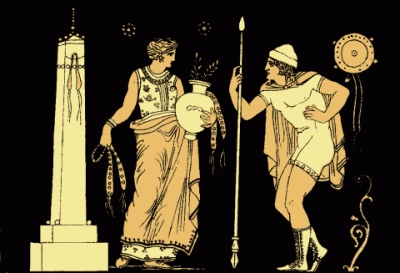

from Stories from the Greek Tragedians by Alfred Church
In addition to fear, a well written tragedy evoked in its viewers a sense of pity at the "unmerited misfortune" befalling the tragic hero (Weitz 155). The tragic hero falls as a consequence of hamartia, some weakness of character or excess of virtue. Frequently, this tragic flaw is a consequence of the hero's own hubris or excessive pride (Kirszner and Mandell 1130). But rather than calling forth censure or criticism of the main character, the viewer was expected to feel compassion. The purging of these emotions of fear and pity, humility and compassion, result in catharsis, or a release from negative emotions as the audience empathizes with the hero. In this way, the tragedy expands beyond the life and circumstances of the main character and becomes a window on human nature (Sachs).
Irony, where reality is different than it is portrayed, often plays a role in the development of a tragedy. Sometimes the audience is aware of things about which the character is oblivious (dramatic irony). Sometimes the character suffers at the hands of fate or the gods, where all attempts to escape one's fate inevitably result in its fulfillment (cosmic irony) (Kirszner and Mandell 1130). Irony often supports the feelings of fear and pity the audience feels, as they recognize the limits of their own knowledge and control of their lives.


